For most international trips to Vietnam, the airport choice is straightforward: fly into Hanoi (HAN) for the north, Ho Chi Minh City (SGN) for the south, or Da Nang (DAD) for central Vietnam. But choosing the right arrival and departure airports can save a surprising amount of time once your itinerary includes places such as Hoi An, Phong Nha, Nha Trang, Phu Quoc, Da Lat or the Mekong Delta.
Vietnam is a long country, and the best airport is not necessarily the one with the cheapest international fare. A slightly different flight plan can remove an unnecessary domestic flight, avoid backtracking or save most of a day’s road travel.
This guide focuses on the airports that are genuinely useful when planning a holiday in Vietnam: where they are, which part of the country they serve and how they can fit into a sensible itinerary.

Which airport should you fly into in Vietnam?
If you already know roughly where your Vietnam journey will begin, this is the quickest way to choose:
| Your first destination | Most useful airport | IATA code |
|---|---|---|
| Hanoi, Ninh Binh, northern Vietnam or a classic north-to-south journey | Noi Bai International Airport, Hanoi | HAN |
| Ho Chi Minh City, Mekong Delta or southern Vietnam | Tan Son Nhat International Airport | SGN |
| Da Nang, Hoi An or central Vietnam | Da Nang International Airport | DAD |
| Nha Trang and the Cam Ranh coast | Cam Ranh International Airport | CXR |
| Phu Quoc Island | Phu Quoc International Airport | PQC |
| Hue | Phu Bai International Airport | HUI |
| Phong Nha and the caves of Quang Binh | Dong Hoi Airport | VDH |
| Da Lat | Lien Khuong International Airport | DLI |
| Quy Nhon | Phu Cat Airport | UIH |
| Ha Long area, when a suitable flight is available | Van Don International Airport | VDO |
For a first trip covering the country from north to south, a particularly efficient combination is often to arrive in Hanoi and fly home from Ho Chi Minh City — or the reverse. This type of open-jaw itinerary avoids returning to your original arrival city simply to catch the flight home.

How many airports are there in Vietnam?
Vietnam currently has 22 operating airports in the national civil aviation network. Some are major international gateways, while others principally serve domestic routes and individual regions of the country.
The distinction between an international airport and a domestic airport can be slightly misleading when planning a holiday. An airport may have international status without offering a useful international flight from your home country on your travel dates. Conversely, a smaller domestic airport can be extremely valuable if it saves several hours on the road.
For most overseas travellers, three airports remain the main gateways to understand: Hanoi (HAN), Ho Chi Minh City (SGN) and Da Nang (DAD).
The three main airports for an international trip to Vietnam
1. Noi Bai International Airport (HAN) – Hanoi and northern Vietnam
Noi Bai International Airport is Hanoi’s airport and the principal gateway to northern Vietnam. If your journey begins with Hanoi, Ninh Binh, Ha Long Bay, Mai Chau, Pu Luong, Sapa, Ha Giang or the northern mountains, HAN is usually the most logical international arrival point.
The airport lies outside central Hanoi, so the transfer into the city should be treated as part of the arrival day rather than as an insignificant final hop. Traffic conditions vary, particularly around peak periods.
Noi Bai has two principal passenger terminals:
- Terminal 1 (T1) – domestic flights;
- Terminal 2 (T2) – international flights.
If you arrive internationally and connect to a domestic flight, you normally need to clear immigration and customs, collect your luggage and move from T2 to T1. The airport operates transport between the terminals, so this connection should not be treated like a simple same-gate transit.
Who should choose HAN? Travellers beginning in northern Vietnam, or anyone planning a classic journey from Hanoi gradually south towards Hue, Hoi An and Ho Chi Minh City.
2. Tan Son Nhat International Airport (SGN) – Ho Chi Minh City and southern Vietnam
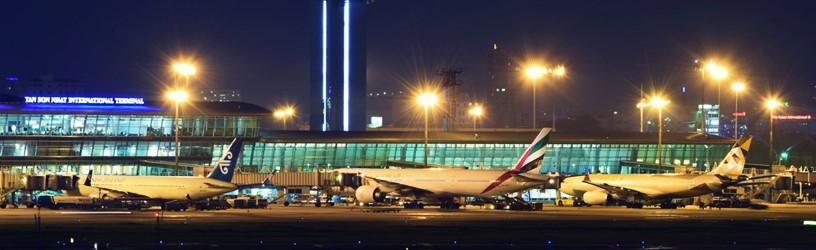
Tan Son Nhat is the airport for Ho Chi Minh City and the principal air gateway to southern Vietnam. It is the natural choice if your journey begins with Ho Chi Minh City, the Mekong Delta or a southern beach extension.
SGN is geographically close to the city compared with many large international airports, but transfer times can still vary considerably because of urban traffic.
One point now deserves particular attention: Tan Son Nhat has three passenger terminals, and domestic flights are not all handled in the same terminal.
- T2 handles international flights.
- T3 handles domestic flights for Vietnam Airlines, Pacific Airlines, VASCO, Bamboo Airways, Vietravel Airlines and Sun PhuQuoc Airways.
- VietJet Air domestic flights currently use T1.
Terminal arrangements can change, so always check the terminal shown by your airline rather than assuming that every domestic flight leaves from T3.
This is especially important if you arrive from overseas and connect onwards to Da Nang, Hue, Nha Trang, Phu Quoc or another Vietnamese destination. Leave enough time not only for immigration and baggage collection, but also for the terminal change and a fresh domestic check-in where required.
Free shuttle buses connect T1, T2 and T3. The terminals are separate, so allow transfer time when changing between international and domestic flights.
Who should choose SGN? Travellers beginning in southern Vietnam, ending a north-to-south journey, or connecting towards the Mekong Delta and southern islands.
3. Da Nang International Airport (DAD) – Hoi An and central Vietnam
Da Nang is the most useful air gateway for much of central Vietnam. The airport is close to Da Nang city and particularly convenient for travellers whose itinerary focuses on Hoi An, Da Nang and the central coast.
Hoi An does not have its own airport. If you see a holiday described as “flying to Hoi An”, the airport involved is normally Da Nang.
Da Nang Airport has two passenger terminals:
- T1 – domestic flights;
- T2 – international flights.
The terminals are close to each other, making a domestic-international connection here relatively straightforward compared with larger airport complexes, although normal immigration, baggage and check-in procedures still need to be allowed for.
Da Nang can also work well as an arrival or departure point in a longer itinerary. For example, a traveller with limited time could combine Hanoi and northern Vietnam with a flight to Da Nang, continue through Hoi An and then fly onwards rather than travelling every sector overland.
Who should choose DAD? Travellers focusing on Hoi An, Da Nang and central Vietnam, or those who want to break a longer journey into more comfortable sections.
Regional airports that can make a Vietnam itinerary much easier
The three major gateways are not always the most useful airports once you are travelling inside Vietnam. Several regional airports can remove a long road journey and make it possible to design a more fluid itinerary.
Cam Ranh International Airport (CXR) – Nha Trang and the coast
Cam Ranh Airport serves Nha Trang and the wider Cam Ranh coastal area. It is the obvious airport for a beach stay around Nha Trang and for resorts situated along this part of Vietnam’s south-central coast.
The airport is outside Nha Trang itself, so remember to consider the road transfer when comparing hotel locations.
Phu Quoc International Airport (PQC) – Phu Quoc Island
PQC is the airport for Phu Quoc. For most travellers adding several beach days at the end of a Vietnam itinerary, flying to the island is much more practical than trying to integrate it into an overland journey.
Phu Quoc can therefore work particularly well as the final stop after Ho Chi Minh City or the Mekong Delta before an onward flight connection.
Phu Bai International Airport (HUI) – Hue
Phu Bai serves Hue and is useful when the former imperial capital is the first or final destination in the central part of your journey.
It is not always necessary to fly between Hue and Da Nang. The road journey between them can form part of the itinerary itself, particularly when continuing via the Hai Van Pass towards Hoi An.
Lien Khuong International Airport (DLI) – Da Lat
Lien Khuong is the airport serving Da Lat and the surrounding Central Highlands. It can save substantial road time if Da Lat is being combined with Hanoi, Ho Chi Minh City or another distant part of Vietnam.
The airport resumed its flight network in August 2026 following runway and infrastructure works, so travellers should still check the available services for their exact dates.
Van Don International Airport (VDO) – Quang Ninh and the Ha Long area
Van Don is geographically useful for Quang Ninh Province and the wider Ha Long area. However, flight availability is much more limited than at Hanoi, so it should be considered only when a suitable service actually fits your dates and itinerary.
For most international travellers visiting Hanoi as well as Ha Long Bay, HAN remains the more natural gateway.
Cat Bi International Airport (HPH) – Hai Phong and Lan Ha Bay
Cat Bi serves Hai Phong and can be useful for certain itineraries involving Hai Phong, Cat Ba or Lan Ha Bay. As with Van Don, its value depends on whether the available flight schedule fits the rest of your journey.
Can Tho International Airport (VCA) – the Mekong Delta
Can Tho Airport sits in the heart of the Mekong Delta and can occasionally make sense for an itinerary beginning or ending deep in southern Vietnam.
For many first-time visitors, however, travelling between Ho Chi Minh City and the Mekong Delta by private road transport remains useful because the journey itself can be incorporated into the route rather than treated simply as a transfer.
Smaller airports that can save a long road journey
Some of Vietnam’s smaller airports are particularly valuable not because they offer many flights, but because of where they are located.
| Airport | Code | Useful for |
|---|---|---|
| Dong Hoi | VDH | Phong Nha-Ke Bang and the caves of Quang Binh |
| Phu Cat | UIH | Quy Nhon and the Binh Dinh coast |
| Buon Ma Thuot | BMV | Dak Lak and the Central Highlands |
| Pleiku | PXU | Gia Lai and parts of the Central Highlands |
| Tuy Hoa | TBB | Phu Yen and the south-central coast |
| Dien Bien | DIN | Dien Bien and some north-western itineraries |
| Tho Xuan | THD | Thanh Hoa Province and selected regional itineraries |
| Chu Lai | VCL | Southern Quang Nam and northern Quang Ngai |
| Con Dao | VCS | Con Dao Islands |
| Vinh | VII | Nghe An and north-central Vietnam |
| Rach Gia | VKG | Kien Giang and selected journeys in the western Mekong region |
| Ca Mau | CAH | The far south of the Mekong Delta |
Flight frequencies at smaller airports can be limited and can change according to demand and airline schedules. The airport should therefore be chosen as part of the itinerary rather than first choosing a flight and trying to build the journey around it.
Which airports work best for a classic Vietnam itinerary?
Northern Vietnam only
Arrive and depart Hanoi (HAN). This is generally the most straightforward choice for a journey built around Hanoi, Ninh Binh, Ha Long Bay and the northern mountains.
Vietnam from north to south
Arrive Hanoi (HAN) and depart Ho Chi Minh City (SGN). This normally avoids unnecessary backtracking and allows the country to unfold naturally from north to centre to south.
Vietnam from south to north
Arrive Ho Chi Minh City (SGN) and depart Hanoi (HAN). There is no reason the classic itinerary has to be travelled in one direction; flight prices, weather and the wider Southeast Asia route may make the reverse direction more logical.
Hoi An and central Vietnam
Use Da Nang (DAD). It is the principal airport for Hoi An and also makes sense for Da Nang and many central-coast itineraries.
Hanoi, Hoi An and Ho Chi Minh City in one trip
A practical combination is often HAN → DAD → SGN, using domestic flights between the three regions rather than spending a large proportion of a shorter holiday in transit.
That does not mean flying is always preferable. On some sectors, travelling by road or train adds worthwhile places and landscapes to the journey. The right balance depends on the number of days you have and what you want to experience between the major cities.
Domestic flights can save time — but do not add them automatically
Vietnam’s length means domestic flights are often very useful. Hanoi to central Vietnam, Hanoi to Ho Chi Minh City and southern Vietnam to Phu Quoc are obvious examples where flying can preserve valuable holiday time.
But a flight is not just the time shown in the timetable. You also need to consider the journey to the airport, check-in, security, baggage collection and the transfer at the destination.
A short flight can therefore make perfect sense over a very long distance, while on a shorter sector a private road journey may be simpler and more interesting.
For more detail on baggage, scheduling and how domestic flights fit into an itinerary, see our Tips for Internal Flights in Vietnam.
Allow enough time when changing from an international to a domestic flight
One of the easiest mistakes when booking Vietnam flights independently is to look only at the scheduled arrival and departure times.
After an international arrival, you may need to:
- clear immigration;
- collect checked luggage;
- pass through customs;
- move to another terminal;
- check in again for the domestic flight;
- pass security again.
The exact procedure depends on the airline, ticket arrangement, airport and connection. Separate tickets deserve particular caution because the second airline may have no responsibility for a missed connection if the first flight arrives late.
When possible, it can be more comfortable to spend the first night in the arrival city rather than attach a tight domestic connection to the end of a long-haul journey — particularly if that city is already part of your itinerary.
Check your airport code, not just the city name
Airport codes are worth checking carefully when booking flights:
- HAN – Hanoi / Noi Bai
- SGN – Ho Chi Minh City / Tan Son Nhat
- DAD – Da Nang
- CXR – Cam Ranh / Nha Trang
- PQC – Phu Quoc
- HUI – Hue / Phu Bai
- DLI – Da Lat / Lien Khuong
- VDH – Dong Hoi / Phong Nha region
The city used in conversation is not always the name of the airport itself. Nha Trang is served by Cam Ranh, Da Lat by Lien Khuong and Hue by Phu Bai. Checking the IATA code removes ambiguity when comparing tickets.
What about Long Thanh International Airport?
As of September 2026, Long Thanh International Airport is not yet handling regular commercial passenger flights. Trial operations are scheduled during the months leading up to its planned commercial opening, currently targeted for 1 December 2026.
Long Thanh is a major new airport east of Ho Chi Minh City and will gradually change how international aviation is organised in southern Vietnam. The transition will not happen in a single step, however, so travellers should always follow the airport shown on their confirmed ticket.
Under the current transition plan, the first phase from December 2026 allows airlines to begin using Long Thanh for international services according to their operating plans, with a broader transfer of international operations scheduled progressively afterwards. If your journey takes place during this transition period, check whether your flight uses SGN or Long Thanh before arranging airport transfers.
Frequently asked questions about airports in Vietnam
What is the main international airport in Vietnam?
Vietnam does not have one airport that is automatically best for every international traveller. Noi Bai (HAN) is the main gateway for Hanoi and the north, while Tan Son Nhat (SGN) serves Ho Chi Minh City and the south. Da Nang (DAD) is the principal gateway for central Vietnam.
Should I fly into Hanoi or Ho Chi Minh City?
Choose Hanoi if your itinerary begins in northern Vietnam and Ho Chi Minh City if it begins in the south. If you intend to travel through the whole country, consider flying into one and home from the other rather than buying a return flight through the same city.
Which airport should I use for Hoi An?
Da Nang International Airport (DAD). Hoi An does not have its own airport. Da Nang is the standard air gateway for Hoi An and the surrounding central coast.
Which airport should I use for Ha Long Bay?
For most overseas visitors combining Hanoi with Ha Long Bay, Noi Bai Airport (HAN) is the most practical gateway. Van Don Airport (VDO) is closer to the Ha Long area but has a much more limited flight network, so it is useful only when a suitable flight matches your itinerary.
Which airport should I use for Phong Nha?
Dong Hoi Airport (VDH) is the closest practical airport for Phong Nha-Ke Bang. Its more limited flight schedule means it should be checked against the rest of the itinerary before booking.
Can I arrive in Hanoi and fly home from Ho Chi Minh City?
Yes. For many two- or three-week Vietnam itineraries this is one of the most efficient arrangements. An open-jaw ticket can avoid flying back to Hanoi solely for the international departure after travelling all the way south — or vice versa.
Are the domestic and international terminals connected at Hanoi Airport?
They are separate terminals. T1 handles domestic flights and T2 handles international flights. Passengers connecting from an international arrival to a domestic flight should allow time for immigration, baggage collection, customs and the transfer between terminals.
Which terminal does my domestic flight use at Tan Son Nhat Airport?
It depends on the airline. Vietnam Airlines, Pacific Airlines, VASCO, Bamboo Airways, Vietravel Airlines and Sun PhuQuoc Airways currently use T3 for domestic operations, while VietJet Air domestic flights use T1. Always check the terminal shown in your airline’s latest flight information.
Is Long Thanh Airport open?
Not for regular commercial passenger operations at the time of this September 2026 update. Official plans currently target commercial operations from 1 December 2026, followed by a phased transfer of international services. Travellers flying during or after the opening period should verify the airport shown on their ticket.
Choose your flights around the journey, not the other way round
The most useful airport combination becomes much easier to see once the itinerary itself is clear. A traveller spending two weeks between Hanoi, Hue, Hoi An and Ho Chi Minh City needs a different flight plan from someone combining the northern mountains with Ha Long Bay, or from a couple finishing their holiday with several nights on Phu Quoc.
This is also why the cheapest international ticket is not always the cheapest journey overall. A fare that forces you to return to the other end of Vietnam can add another flight, another airport transfer and valuable time that could have been spent travelling.
At Tonkin Voyage Travel, we normally consider international arrival and departure points together with the route through Vietnam. The aim is simple: use flights where they genuinely save time, use road or rail where the journey itself is worthwhile, and avoid unnecessary backtracking.
If you already have international flights in mind, send us the dates and airport options together with the places you would like to visit. They can then be considered as part of the itinerary rather than as a separate booking decision.
Travel Guide
What clients say about us