Planning a trip to Vietnam and wondering whether you need a visa? For many travellers, the answer is now quite simple: Vietnam currently allows citizens of 24 countries to stay visa-free for up to 45 days, while several other nationalities benefit from separate bilateral visa-exemption agreements.
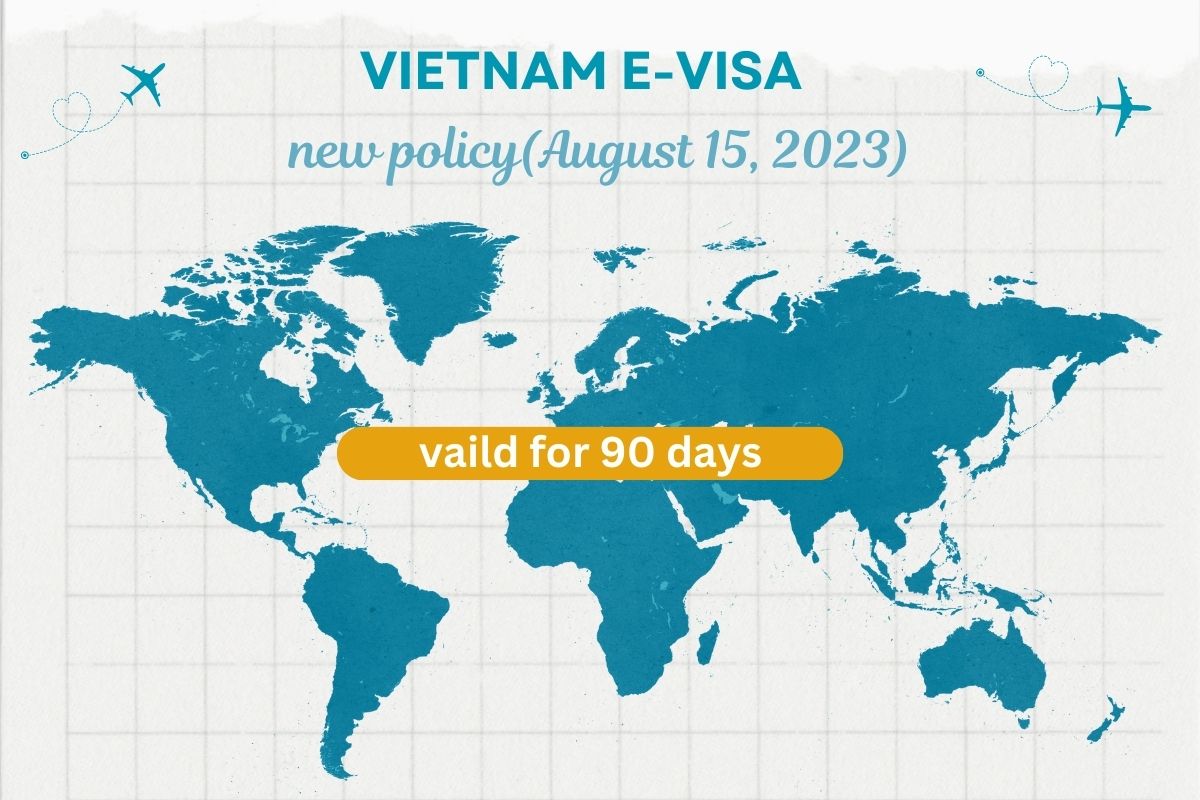
If your passport is not covered, or if you want to stay longer, Vietnam’s official e-visa can be valid for up to 90 days, with single or multiple entry.
The important thing is to check the rule for your passport, the length of your trip and, in some cases, your reason for travelling. The guide below keeps things practical so you can quickly work out which option fits your journey.
Quick answer: 12 nationalities can currently enter Vietnam visa-free for up to 45 days regardless of purpose of travel, while 12 additional European nationalities receive the same 45-day exemption for tourism purposes. Other travellers may qualify under bilateral agreements or can apply for an e-visa where appropriate.
1 – Who Can Visit Vietnam Visa-Free for 45 Days?
Vietnam currently has two groups of travellers who can stay for up to 45 days without a visa. The practical difference is that the first group can use the exemption regardless of purpose of entry, while the second group receives it specifically for tourism.
| Who qualifies? | Visa-free stay |
|---|---|
| 12 countries in the first exemption group | Up to 45 days, regardless of passport type or purpose of entry |
| 12 additional European countries | Up to 45 days for tourism |
1.1 – First group: 12 countries with 45 days visa-free
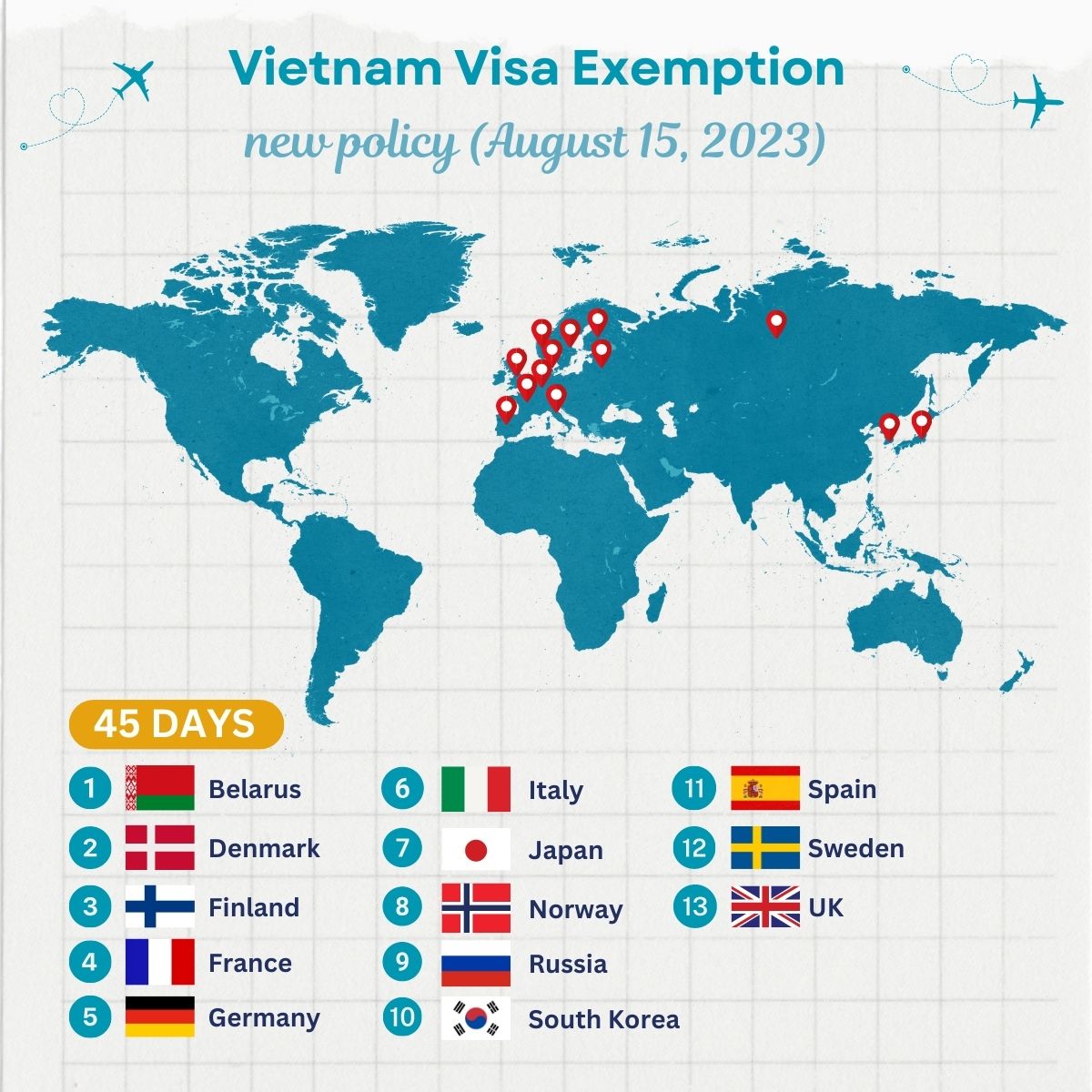
Citizens of the following countries can currently visit Vietnam without a visa for up to 45 days from the date of entry:
- Denmark
- Finland
- France
- Germany
- Italy
- Japan
- Norway
- Russia
- South Korea
- Spain
- Sweden
- United Kingdom
This policy currently runs from 15 March 2025 to 14 March 2028. It applies regardless of passport type or purpose of entry, provided you meet Vietnam’s normal entry conditions.
UK travellers: eligible UK passport holders can use the 45-day exemption, but British National (Overseas), or BNO, passports are not covered by this exemption.
1.2 – Second group: 12 additional countries with 45 days visa-free for tourism
Travelling to Vietnam for a holiday? Citizens of the following 12 European countries can also stay visa-free for up to 45 days:
- Belgium
- Bulgaria
- Croatia
- Czech Republic
- Hungary
- Luxembourg
- Netherlands
- Poland
- Romania
- Slovakia
- Slovenia
- Switzerland
This exemption currently runs from 15 August 2025 to 14 August 2028. Unlike the first group above, this 45-day exemption is specifically for tourism purposes.
For a normal holiday, this is straightforward: if you hold an eligible passport, your trip is for tourism and your stay is within 45 days, you normally do not need to apply for an e-visa before travelling, provided you meet the applicable entry requirements.
Good to know: the two groups both receive up to 45 days, but they are not legally identical. For most leisure travellers, the practical question is simply whether your passport is listed and whether your trip fits the conditions of the exemption.
2 – Other Countries That Can Visit Vietnam Without a Visa
The 45-day exemptions are not the only visa-free options. Vietnam also has agreements with several countries whose ordinary passport holders can visit without a visa for shorter or, in some cases, longer stays.
For leisure travellers, the following are some of the most useful current examples:
| Country | Visa-free stay for ordinary passport holders |
|---|---|
| Belarus | 30 days per visit; maximum 90 days in a calendar year |
| Brunei | 14 days |
| Cambodia | 30 days |
| Chile | 90 days |
| Indonesia | 30 days |
| Kazakhstan | 30 days per visit; maximum 90 days within 180 days |
| Kyrgyzstan | 30 days |
| Laos | 30 days |
| Malaysia | 30 days |
| Mongolia | 30 days |
| Myanmar | 30 days |
| Panama | 90 days |
| Philippines | 21 days |
| Singapore | 30 days |
| Thailand | 30 days |
This table focuses on ordinary passports and the rules most relevant to leisure travellers. Different conditions can apply to diplomatic, official, service or other passport types.
What should Belarusian travellers know?
Belarus is sometimes still shown on older websites as part of Vietnam’s former 45-day exemption list. The current arrangement is different.
Under the bilateral agreement effective from 30 January 2025, Belarusian ordinary-passport holders may stay visa-free for up to 30 days per visit, with total visa-free stays not exceeding 90 days in a calendar year.
What should Kazakhstan travellers know?
Kazakhstan ordinary-passport holders can stay visa-free for up to 30 days per visit, with total stays not exceeding 90 days within a 180-day period.
3 – Do I Need a Visa for My Vietnam Trip?
For most travellers, you can work this out in less than a minute.
Step 1 – Find your passport in the lists above
If your nationality is covered by a visa exemption, note the maximum stay and any special condition, such as the tourism-purpose requirement for the second 45-day group.
Step 2 – Compare it with your travel dates
If you qualify for 45 days visa-free and your Vietnam holiday lasts two or three weeks, you normally do not need an e-visa for that stay, provided you meet the relevant entry conditions.
If your trip is longer than your visa-free allowance, look at the e-visa option before departure.
Step 3 – Check whether you leave Vietnam and come back
This matters on multi-country trips. If you visit Vietnam, continue to Cambodia or Laos and then return to Vietnam, make sure your entry arrangements cover the return journey. A multiple-entry e-visa may be useful for some itineraries.
4 – Vietnam E-Visa: The Practical Basics
If you are not covered by a visa exemption, or you want to stay longer, Vietnam’s official e-visa is usually the first option to check.
Vietnam e-visa at a glance: valid for up to 90 days · single or multiple entry · US$25 for single entry · US$50 for multiple entry.
How long can a Vietnam e-visa be valid?
A Vietnam e-visa can be valid for up to 90 days. Depending on your travel plan, you can apply for either single or multiple entry.
How much does a Vietnam e-visa cost?
- US$25 for a single-entry e-visa
- US$50 for a multiple-entry e-visa
The official application fee is non-refundable if the visa is not granted.
Where should I apply?
Use the official Vietnam Immigration Department website: evisa.gov.vn.
The authorities also list thithucdientu.gov.vn as an official domain. Be careful with private websites that look like government portals but charge additional service fees.
How do I apply?
- Complete the online application carefully.
- Upload the requested passport data-page image and portrait photograph.
- Enter your travel and entry details accurately.
- Pay the e-visa fee.
- Keep your registration details so you can check the result.
- Once approved, download and print a copy of your e-visa and keep it with your travel documents.
Official guidance states that applications are normally processed within three working days. It is still sensible to apply well before departure in case you need to correct a photo, passport detail or other information.
Can I use a new e-visa to extend my stay while I am already in Vietnam?
Do not treat a new e-visa as an automatic way to extend an existing stay from inside Vietnam. The official personal e-visa application route is intended for foreigners outside Vietnam who wish to enter the country.
If you want to stay longer than your current authorised period, check the latest options with Vietnam’s Immigration Department before that period expires rather than relying on old “visa run” advice.
5 – Can I Visit Phu Quoc Without a Visa?
Yes, in certain circumstances. Phu Quoc has a special visa-exemption policy allowing eligible foreign passport holders to stay on the island for up to 30 days without a visa.
Vietnam’s official guidance also allows qualifying travellers to transit through another international border gate in Vietnam before continuing to Phu Quoc under the conditions of the scheme.
The important part: the Phu Quoc exemption is for a stay on Phu Quoc. It does not by itself give you permission to continue travelling around mainland Vietnam.
If your holiday also includes Hanoi, Ha Long Bay, Hue, Hoi An, Ho Chi Minh City, the Mekong Delta or another mainland destination, check the normal visa or visa-exemption rules for your passport.
6 – New in 2026: Pre-Arrival Information Declaration
Travellers arriving by air should also be aware of Vietnam’s new Pre-Arrival Information Declaration, introduced during 2026 as immigration procedures become more digital.
An official notice published on 2 July 2026 encourages foreign travellers using the following airports to complete the declaration:
- Noi Bai International Airport – Hanoi
- Tan Son Nhat International Airport – Ho Chi Minh City
- Da Nang International Airport
- Cam Ranh International Airport – Nha Trang
- Phu Quoc International Airport
The declaration can be completed within three days before arrival or upon arrival. Completing it before your flight may help reduce waiting time at immigration.
Official portal: prearrival.immigration.gov.vn.
Check again before you fly: implementation guidance has varied during the 2026 rollout, so follow the latest instructions for your specific arrival airport. This declaration is separate from your visa or visa exemption.
7 – Vietnam Visa FAQs
Do I need a visa for Vietnam in 2026?
It depends on your passport and how long you plan to stay. Citizens of 24 countries currently qualify for a 45-day visa exemption under two different schemes, while several other nationalities receive visa-free entry under bilateral agreements. If you are not exempt, check Vietnam’s official e-visa system.
Which countries can visit Vietnam visa-free for 45 days?
The current 24 countries are Belgium, Bulgaria, Croatia, Czech Republic, Denmark, Finland, France, Germany, Hungary, Italy, Japan, Luxembourg, Netherlands, Norway, Poland, Romania, Russia, Slovakia, Slovenia, South Korea, Spain, Sweden, Switzerland and the United Kingdom. The additional group of 12 European countries receives the exemption specifically for tourism.
Is the 45-day Vietnam visa exemption valid until 2028?
Yes, under the policies currently in force. The first 12-country scheme runs until 14 March 2028, while the additional 12-country tourism exemption runs until 14 August 2028.
Do US citizens need a visa for Vietnam?
US ordinary passport holders are not included in the current 45-day visa-exemption groups. For a normal Vietnam holiday, American travellers should therefore check the official e-visa system unless another specific exemption applies.
Do UK citizens need a visa for Vietnam?
Eligible UK passport holders can currently stay visa-free for up to 45 days. British National (Overseas), or BNO, passport holders are not covered by this exemption.
Do French, German, Italian and Spanish citizens need a visa?
Citizens of France, Germany, Italy and Spain currently qualify for up to 45 days visa-free, provided they meet Vietnam’s normal entry conditions.
Do Australian, Canadian or New Zealand citizens need a Vietnam visa?
Australia, Canada and New Zealand are not included in the current 24-country 45-day exemption groups. Ordinary passport holders from these countries should therefore check the official Vietnam e-visa system unless another specific exemption applies.
How long can I stay in Vietnam without a visa?
It depends on your passport. Some travellers qualify for up to 45 days, while bilateral agreements may allow stays of 14, 21, 30 or 90 days.
Can I get a 90-day Vietnam e-visa?
Yes. Vietnam’s e-visa can be valid for up to 90 days and can be issued for single or multiple entry.
How much does a Vietnam e-visa cost?
The official fee is currently US$25 for single entry and US$50 for multiple entry.
Should I print my Vietnam e-visa?
Yes. Once your e-visa is approved, download and print a copy to keep with your travel documents for entry and exit procedures.
Can I visit Phu Quoc without a Vietnam visa?
Eligible foreign passport holders may stay visa-free on Phu Quoc for up to 30 days under the island’s special exemption. This does not by itself allow onward travel to other parts of Vietnam.
Is Vietnam’s Pre-Arrival Information Declaration mandatory?
Official guidance has varied during the 2026 rollout. A 2 July 2026 notice encourages travellers using five major airports to complete the declaration before arrival, but you should follow the latest instructions for your specific airport before travelling.
8 – Before You Fly: A Quick Vietnam Entry Checklist
- Check whether your passport qualifies for visa-free entry.
- Confirm exactly how many days you are allowed to stay.
- If you are using the additional 12-country exemption, make sure your visit is for tourism.
- Check your passport validity before booking or flying.
- If you need an e-visa, make sure every detail matches your passport exactly.
- If you leave Vietnam and return during the same trip, check whether you need multiple entry.
- Download and print your approved e-visa if you are travelling with one.
- Check the latest Pre-Arrival Information instructions for your arrival airport shortly before departure.
Visa and immigration rules can change. If your circumstances are unusual or anything is unclear, check directly with Vietnam’s Immigration Department or the Vietnamese embassy or consulate responsible for your place of residence before travelling.
9 – How Long Should You Actually Spend in Vietnam?
If you qualify for the 45-day exemption, immigration rules may give you much more time than you actually need for a first trip.
Two weeks can work well for a focused itinerary, three weeks gives you more breathing room, while four weeks or longer allows for a slower journey through several regions without rushing.
If you are still deciding, see our guide: How Many Days Do You Need in Vietnam?
It is also worth thinking about where you arrive and depart. Flying into Hanoi and out of Ho Chi Minh City, or travelling in the opposite direction, can save unnecessary backtracking. See our guide to Airports in Vietnam.
Planning a wider Southeast Asian trip? You may also find Vietnam, Cambodia, Laos, Thailand or Myanmar: Which Country Should You Visit? useful.
10 – Planning Your Vietnam Journey
Vietnam’s current entry rules give many international travellers plenty of flexibility. The more useful question is often not how long you are allowed to stay, but how to use your time well.
At Tonkin Voyage Travel, we create private journeys around the time you have, the places you genuinely want to see and the pace that feels right for you. A trip can focus entirely on Vietnam or combine it naturally with Cambodia, Laos or Thailand.
Need help shaping your Vietnam itinerary? Contact Tonkin Voyage Travel.
Useful Official Links
Entry rules can change, so these official English-language sources are useful for checking the latest information before you travel:
- Vietnam Government – 45-day exemption for the first 12 countries: Current visa-exemption policy until March 2028
- Vietnam Government – additional 12-country exemption: Visa exemption for citizens of 24 countries
- Vietnam Immigration Department: Official Vietnam e-visa system
- Vietnam Ministry of Foreign Affairs: English treaties database
- Vietnam Government – Phu Quoc: Phu Quoc visa-free policy and e-visa entry information
- Vietnam Embassy in Singapore – 2026 arrival declaration: Pre-Arrival Information Declaration notice
Always check the latest official requirements shortly before departure, especially if you are reading this guide several months after it was last reviewed.
Travel Guide
What clients say about us